


Pragmatic Lessons on Culture, Accountability, and How Leaders Shape Behaviour
March 17, 2026
In this edition of Farient’s Q&A series, Simon Patterson speaks with Julia Hobart about leadership, culture, and judgement—through the lens of her long experience at the intersection of investment decision‑making and institutional governance.
Julia began her career in asset management, including roles at SG Warburg and Mercury Asset Management (now part of BlackRock), before moving into investment consulting and strategy. She joined Mercer then Oliver Wyman in 2004 following Oliver Wyman’s acquisition then went on to spend two decades as a Partner in Oliver Wyman’s Insurance & Asset Management practice. Now Partner Emeritus, she combines selective advisory work with a portfolio of investment‑related non‑executive roles.
In this fast‑paced conversation, Julia reflects on what boards should pay closest attention to, but often underestimate: behaviour, incentives, and culture. She argues that promotion systems shape conduct more powerfully than policy statements; that meritocracy only works when leaders are willing to be accountable for the talent beneath them; and that culture, for better or worse, is set unmistakably from the top.
Simon and Julia also explore how boards should think about talent risk, internal markets, and emerging technologies such as artificial intelligence (AI). Pragmatic, direct, and grounded in experience, Julia’s perspective will resonate with non‑executive directors and senior executives navigating complexity, ambiguity, and heightened scrutiny; in other words, their work in today’s boardrooms This is a conversation about governance not as theory, but as practice – revealed in everyday decisions, incentives, and leadership behaviour.
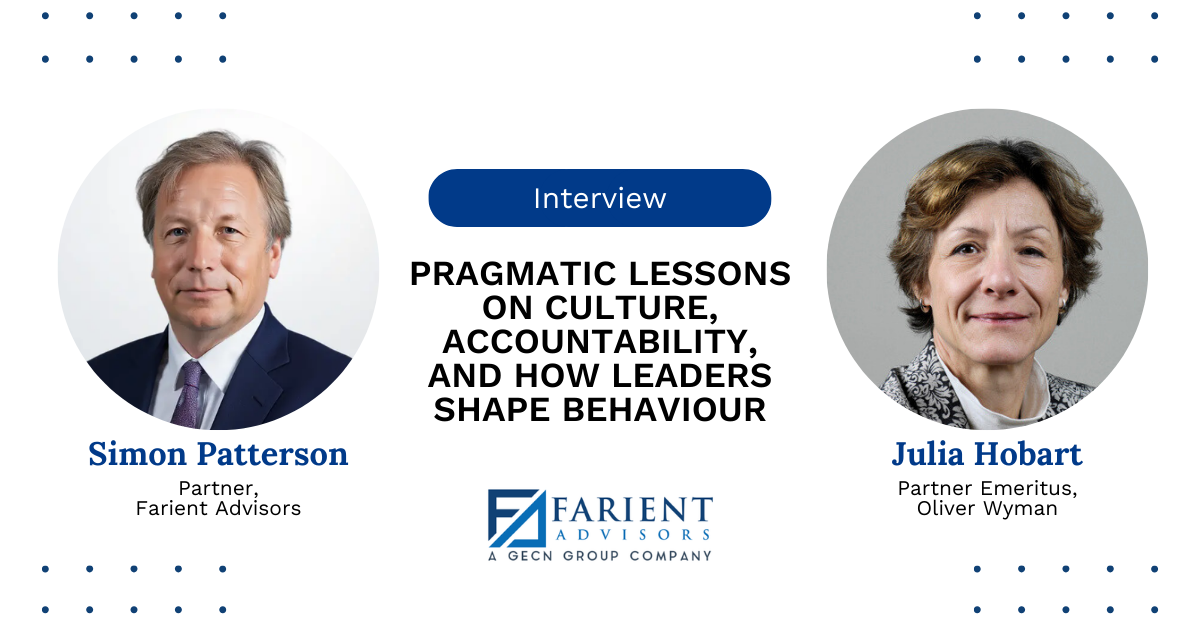
Simon: Let’s start with your background. You’ve had an unusually broad career – often building things from scratch rather than stepping into established roles. Could you talk us through how your early career unfolded, what drew you from the investment side into consulting, and how those transitions shaped the way you think about leadership and opportunity?
Julia Hobart: I started in London working for what was then called a merchant bank, which was quite a competitive situation, but I was lucky because at the time I had an unusual combination of degrees in maths and computer science. I moved after about eight years to investment consulting, when a friend introduced me to Mercer. What attracted me was not so much the content of its work, although it was around investment, but that I was given a chance to build something and manage people. I recognised the opportunity and launched myself into it. I built an investment consulting business in continental Europe. It was quite a challenge, because investment consulting didn’t exist at that time in continental Europe and so no one knew anything about it. They didn’t really believe that it was necessary. There was a lot of knocking on doors and being greeted by blank stares. I then moved within Mercer to build a business advising asset managers and eventually that became quite a big business. Mercer then acquired Oliver Wyman. So, as you can see, I’m not very adventurous. I changed employers without moving jobs!
Simon: What is the message in a bottle you would send to your peers to find five years from now?
Julia Hobart: There are at least two things that are quite important. One is to build skills, because they are adaptable to changing environments. One skill, particularly for those who aspire to senior leadership, is being able to deep-dive into the detail whilst stepping back to see the context of it all.
Second is the ability to understand where people are coming from – seeing from their point of view. It doesn’t mean you have to agree with them. What it means is you can understand them. Back to context. We don’t quite know where the world’s going, but the optimist – and I am an optimist – sees opportunity in challenge. My advice to anyone is to try to say ‘yes’ to new opportunities and surround yourself with people you like and trust. That’s my recipe.
Simon: How are you thinking about the opportunities represented by AI?
Julia Hobart: We’ve probably been through three or four sea-changing innovations like AI in our lifetimes, though AI is changing things very fast. For that, it’s helpful to build experience in AI, so employees and organisations know what it does and what it can do. If organisations tell their staff, they aren’t allowed to use AI then their staff will have missed that valuable early-stage opportunity to play around with the technology. Obviously, one needs to be mindful of confidentiality and the potential for abuse, but with more exposure people can work out how it can save them time. For organisations, the question is not only how can they do what they do better and faster, but also what do they need to change to capture the benefits?
Simon: Based on your considerable experience, what would you say absolutely must be avoided by someone running a talent-based business?
Julia Hobart: Everybody – and not just the client-facing team – working in that organisation ought to have positive input. The revenue-generating parts of the business are always regarded more positively than the support parts. Something that manifests in all organisations, but good organisations are smart about how they value their people, so everyone feels valued and is clear about their purpose, contributions and abilities. Happy people contribute more.
Simon: How do you attract and retain top talent? Is it about incentives, promotion opportunities, or softer stuff? What’s your sense?
Julia Hobart: There are a few things to attracting and retaining people. One of them is dependent on what I’ll call content. Think of the big investment firms: what attracts people to the organisations I’ve worked for, particularly Warburg and Oliver Wyman, is the interesting work that they do and the opportunities that it creates. Of course, there are incentives, promotion opportunities, and the like, but it is very hard to work at 100+% if the work isn’t fulfilling. It would be naïve not to say that an organisation’s brand and reputation are important factors too.
Simon: What do you find off-putting when hiring?
Julia Hobart: The way people interact with others, whether they’re considerate or all mouth and no ears. I have done a lot of interviewing across different organisations and levels of seniority, and for example if someone treats you like a schmuck from the start that kind of behaviour reveals a complete lack of awareness. As far as I am concerned, I would never want to work with such people, and don’t see why anyone else should either. It has nothing to do with personality as such, it is about an outsized ego.
Simon: Emotional intelligence vs. intelligence. Have you worked in environments that are “up and out”, or where promotion is expected and pursued?
Julia Hobart: Somewhere in the middle of those two. I believe promotion should be earned, not anointed, and not as clinical as ‘up or out’. One approach I’ve experienced that’s positive is where, before a milestone promotion, candidates have an advocate and independent reviewer which means they do not need to sharpen their elbows or sweeten up the committee. In parallel they still must pitch their case to a review committee as well as being known for some capability and have a reputation for being able to work with people. At the more senior levels, they also need to demonstrate they can feed themselves and others around them. It’s a more genuine measure of competence.
Simon: How people are paid ultimately might describe the internal market within a consulting firm. If you are good and in demand, people want you on their team, which speeds promotion, and with promotion comes more money. Is that correct?
Julia Hobart: Yes, absolutely correct. The way to earn more is to get promoted. You can be promoted faster by being good and in demand, but some people think they are better than they actually are and react badly when they aren’t promoted. What is interesting is that pretty much everyone has a bad year (or a missed promotion) at some point in their career, and how they handle the disappointment is hugely important. Those that take on the learnings very often go on to great success.
Simon: Can a bad culture in a professional services environment be fixed?
Julia Hobart: Changing culture is really hard. Culture is set from the top – the CEO should set the tone, but it can’t be the CEO alone – the top team needs to be on board too and to cascade it down through their teams. To change the culture probably means change at the top. On reflection, I don’t think I’ve seen an organisation change culture without a change in its leadership. There must be a bit of stick involved with the carrot.
I can think of an organisation where the CEO was distant and unapproachable. A new CEO came in who was more accessible and talked to people. They had drop-in hours and encouraged people to speak or email the CEO with a problem and a suggested fix. This was quite effective. Personally, I’m very happy for people to complain, but it must be constructive.
Simon: Do you think that meritocracy management can be applied to entrepreneurial technology-based businesses?
Julia Hobart: A meritocracy approach lends itself to businesses with high content, such as technology or knowledge-driven specialisations. In this case there must be a mechanism for measuring it or for somehow acknowledging it. Whereas in a hierarchical structure, it’s much harder to work your way through the layers because the person above you may be protecting their position. That’s quite cultural. The way to change that perhaps is to mark down those people who don’t promote their junior staff.
Simon: What about in large organisations?
Julia Hobart: Meritocracy is harder to single out in a large organisation, but I do think culture is an important factor. If the culture is based on performance, deliverables, and contributory behaviour rather than tenure or muscling into position, then the process should reward good behaviour, and disincentivise bad behaviour. Key though is that this is enshrined in the culture as well as the processes.
Want to explore more of Simon Patterson’s interviews? Find them below.
- An Esteemed NED on Rules of Engagement: Clarity, Simplicity, and Consistency
- Blending Culture, Building People: Natalia Mikulich on JTI’s Transformation Journey
- A Fiercely Independent Asset to Pension Fund Oversight
- Culture Over Cash: Rethinking Rewards with Peter Newhouse
- Influencing Success: How Board Members Make a Difference
- Recognition and Appreciation: Magic Ingredients for Employee Engagement and Investment
© 2026 Farient Advisors LLC. | Privacy Policy | Site by: Treacle Media