


Quantum Leap? What the 2026 AGM Season Reveals About the Future of UK Executive Pay
July 16, 2026
Since 2008, shareholders have pushed hard to limit executive pay increases and establish additional features not seen in most other governance regimes (such as pension equalisation, holding periods, bonus deferral, post-employment share ownership guidelines). This AGM season has seen companies push through larger quantum increases and reduce or eliminate bonus deferral, with little resistance from shareholders.
Corporate Britain Answers Back
Contrary to the 2012 “shareholder spring”, this is the year that companies and management have bitten back. With larger quantum increases, bespoke incentive structures introduced, and removal of some “shareholder-friendly” pay features, greater pushback from shareholders may have been expected, yet not a single Policy has failed this season. Moreover, no company has lost a DRR vote – a first in over a decade.
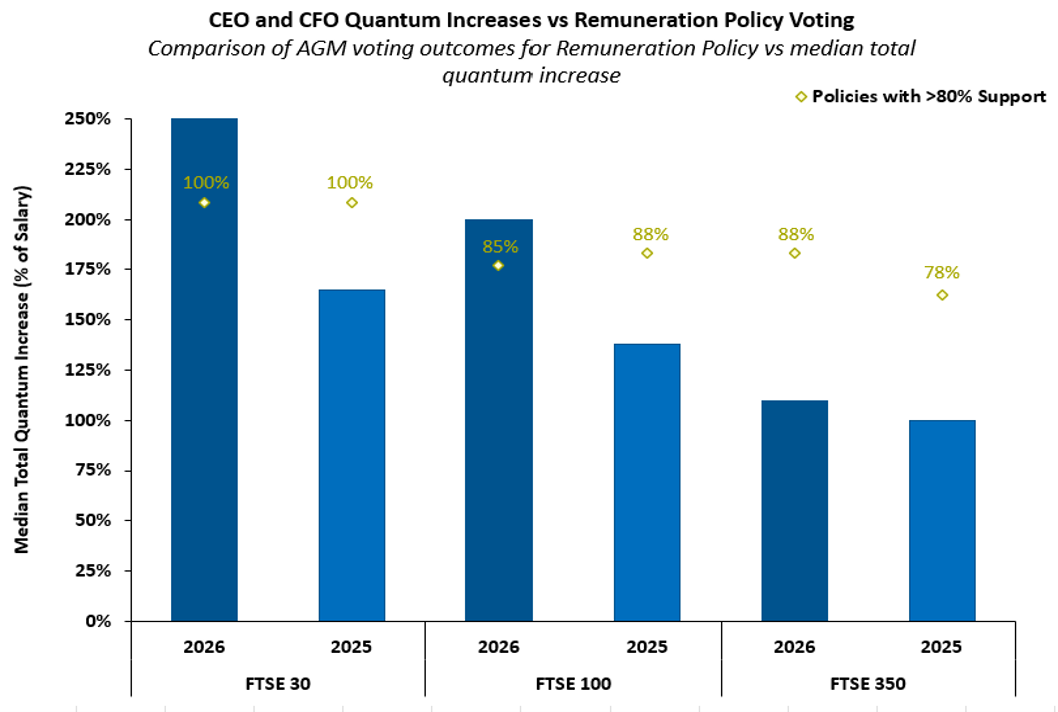
- 40% of new FTSE 350 Policies proposed a total quantum increase of at least 100% of salary, with the highest so far being 485% of salary
- Of those companies proposing an increase of 100% of salary or more, the median increase was 200% of salary for the CEO and 165% of salary for the CFO, with average support of 90% at the AGMs
- Three companies increased quantum by more than 400% of salary – one secured 98% support, although the other two companies received lower votes of 60% and 76%
US Exposure Splitting FTSE 350 Pay
A distinct tiering of FTSE pay levels is developing, driven by companies’ exposure to the US. Interestingly, the more US exposure, the bolder the quantum increases and the stronger the rationale behind them. Shareholders have been largely supportive of proposals that cited the need for competitiveness in the global talent market from companies that generate a significant portion of revenues in the US.
This, however, is increasingly leaving UK-centric businesses notably further behind on pay, as evidenced by maximum variable pay opportunities (see Tier 3 in the charts provided).
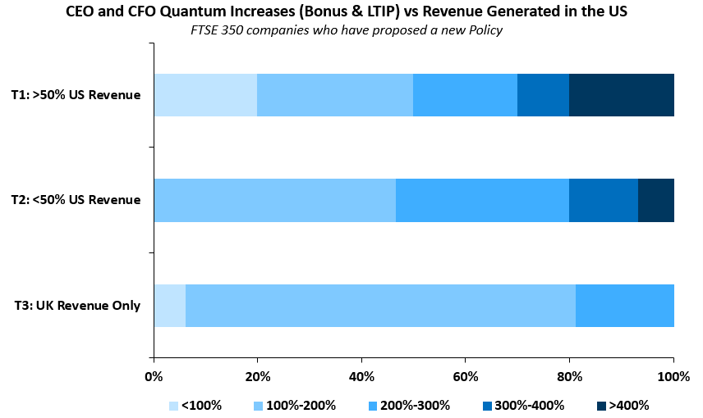
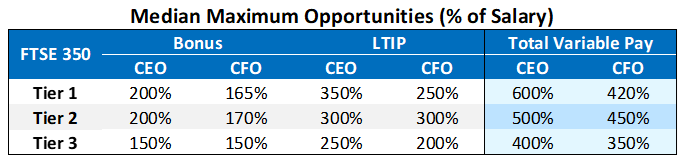
The middle tier is where the strong rationale for incentive increases is especially important. Here, companies with some US exposure cannot comfortably justify the same levels of quantum as Tier 1, which is reflected in the level of proposed uplifts we have seen from them this AGM season. Only a fifth of increases in Tier 2 companies exceeded 300% of salary, compared with a third in Tier 1.
It is becoming clear that a company’s geographic revenue footprint is emerging as an important factor in where it sits in an increasingly hierarchical FTSE pay landscape.
The Widening Gap Between CEO and CFO Pay
Paying CEOs at a premium has long been standard in the US and it’s now taking hold in the UK too. Variable pay opportunities are increasingly skewed in the CEO’s favour, with the gap most pronounced in the FTSE 100 – a sign that UK pay practice may be gradually shifting closer to the US model with “rainmaker” CEOs.
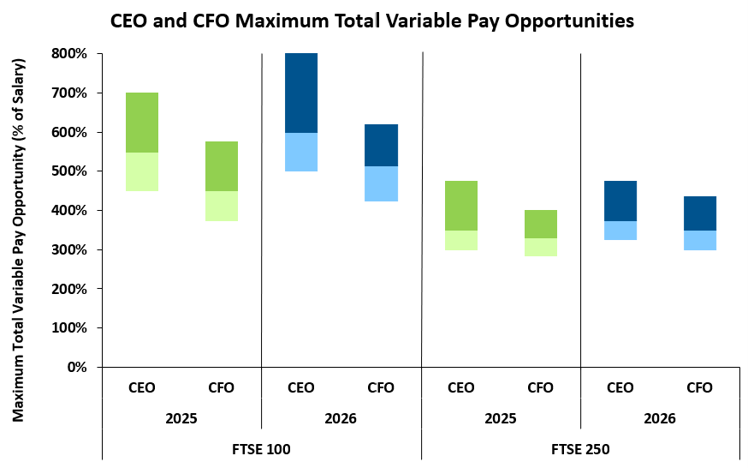
- Following this year’s quantum increases, the gap between CEOs and CFOs is even more pronounced, nearing 200% of salary at the upper quartile in the FTSE 100, compared with 125% last year
- 60% of FTSE 100 companies putting forward a new Policy have increased the CEO’s variable pay opportunities by at least 100% of salary, compared with 40% doing the same for the CFO – the median increases being 200% of salary for the CEO and 125% for the CFO
- Around half of the FTSE 350 CEOs now have a higher bonus opportunity than the CFOs, and this figure rises to approximately 70% for LTIPs
Diverging Approaches to ESG
As shareholders push for more robust and stretching incentive targets, especially in the context of quantum increases, ESG metrics are facing tougher scrutiny.
There is a noticeable difference in the approach to ESG among companies that proposed increases of 100% of salary or more.
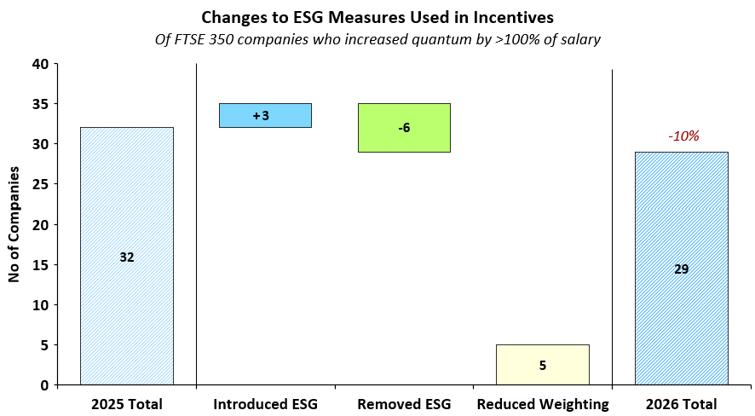
- Three of those companies have introduced ESG measures in their incentives
- The majority use quantitative targets, but over a third rely on a subjective, judgement-based assessment at the end of the performance period
- Five companies have reduced the weighting of ESG measures and six have removed ESG from their incentives altogether – in some cases this resulted in a higher weighting on financial measures
It is clear that the market still hasn’t agreed on what good ESG performance looks like and whether meeting ESG targets should be captured in an incentive arrangement or should be a business imperative that should be done as a basic minimum.
Summary of Key Trends
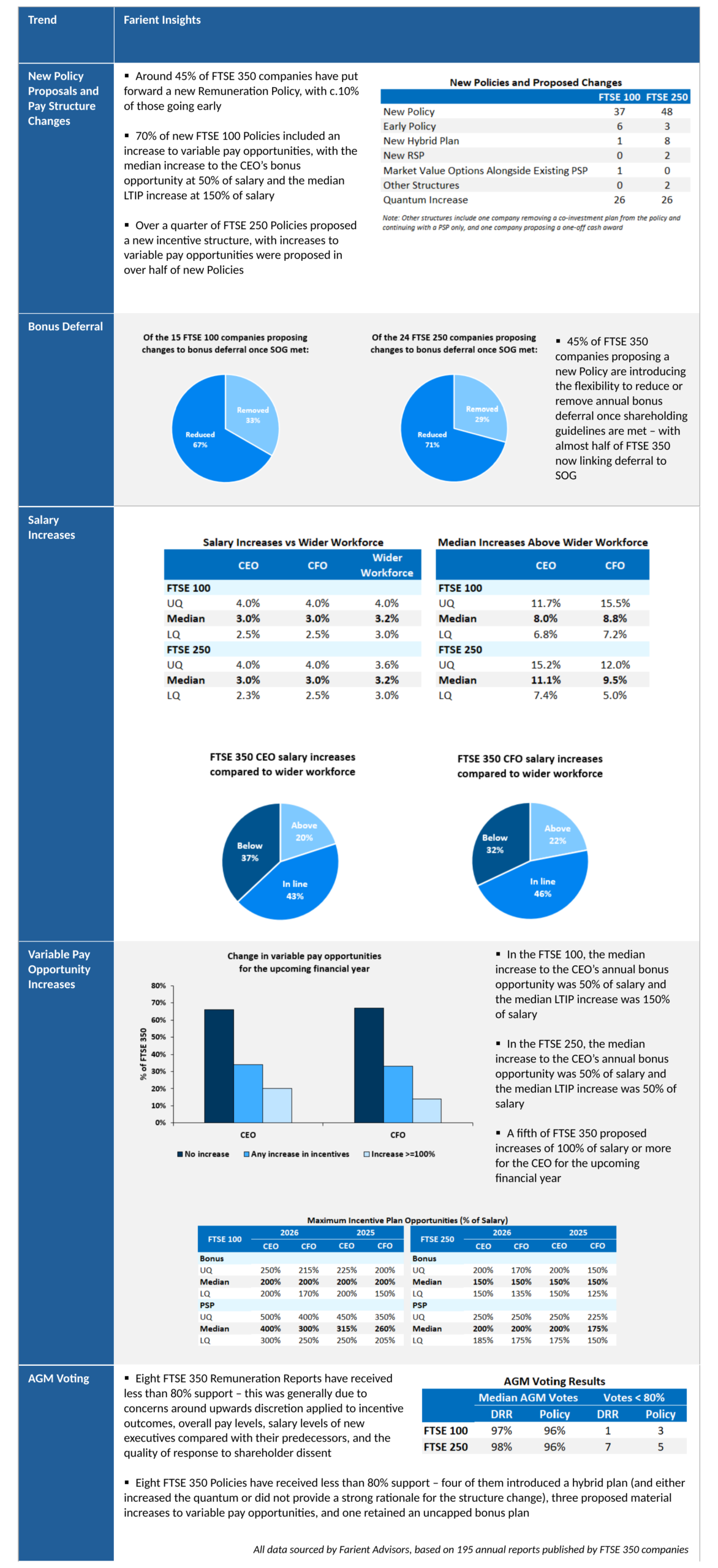
More Farient insights into how the 2026 AGM season is unfolding are summarised below.
As the 2026 AGM season progresses, Farient will continue to monitor and report on market developments. Should you wish to discuss these updates, please contact either Stephen Cahill (stephen.cahill@farient.com), David Cohen (david.cohen@farient.com), Fiona Maurice (fiona.maurice@farient.com) or Alex Styles-Morris (alex.styles-morris@farient.com).
|
Stephen
Cahill  📍 51 Moorgate, 5th Floor, 📞 +44 7784 474845 |
David
Cohen  📍 51 Moorgate, 5th Floor, 📞 +44 7538 901395 |
|
Fiona
Maurice  📍 51 Moorgate, 5th Floor, 📞 +44 7572 494214 |
Alex
Styles-Morris  📍 51 Moorgate, 5th Floor, 📞 +44 7773 904547 |
© 2026 Farient Advisors LLC. | Privacy Policy | Site by: Treacle Media