


Positive Discretion – A Red Line or Changing Boundary?
October 14, 2026
The 2026 AGM season was a pivotal moment in demonstrating a more open environment for UK-listed companies seeking approval for more globally competitive pay frameworks.
As shown in Farient’s recent analysis, the majority of FTSE policy changes focused on material increases to opportunities under existing annual bonus and/or performance share plans (PSPs), with more limited examples of companies mirroring the “hybrid” approach to long-term incentive plans seen across the Atlantic.
The grant of materially enhanced performance-based awards, typically subject to multiple financial and strategic performance metrics, places increased pressure on remuneration committees ‘getting it right’ when it comes to target setting, particularly in a world where corporate strategies are adapting and evolving faster than ever. For example, rapid changes in geopolitics and AI are forcing many companies to move away from the traditional five-year ‘set the plan and execute’ approach towards more frequent reprioritisation and dynamic strategy loops.
So, what happens when strategies shift and performance targets become misaligned with actual value creation, or unfairly reflect management’s contribution at the end of the performance period?
While the use of discretion to reduce formulaic incentive outcomes is established practice in the UK market – with around 10%-15% of companies applying negative discretion in any year – positive adjustments remain relatively uncommon. However, with total incentive opportunities of over 10x salary per year in the largest FTSE companies, the stakes are high. In a highly volatile environment where long-term target setting presents challenges, ensuring outcomes that are fair for management, investors, and wider stakeholders will be a growing area of focus.
Use of Discretion in FTSE 350 – The Only Way is Down?
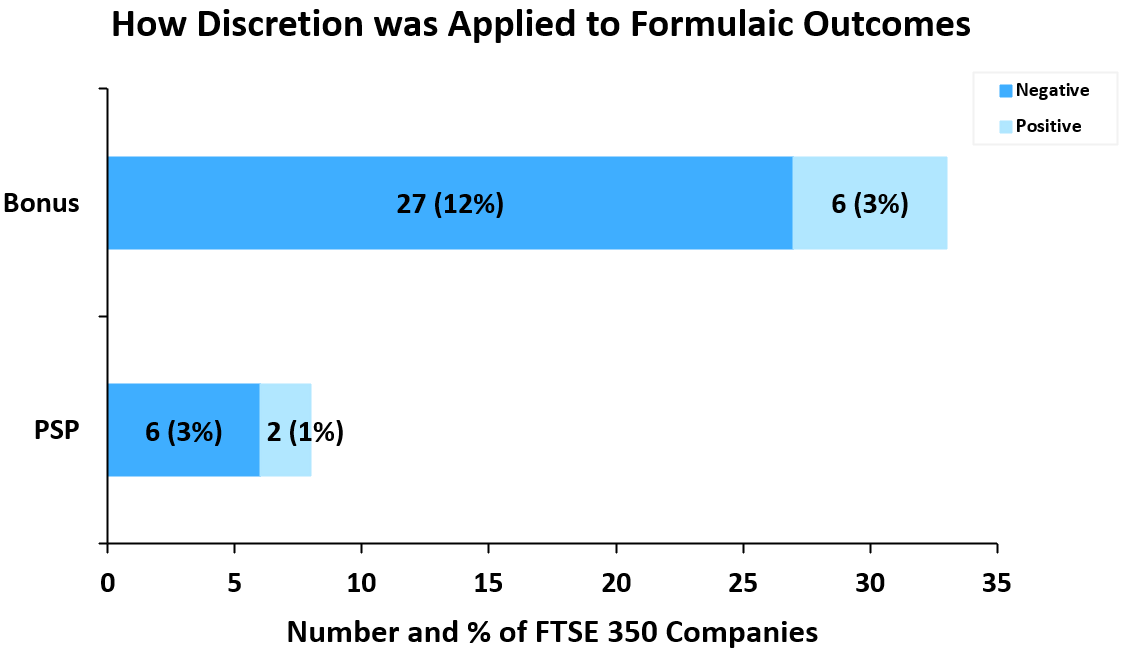
18% of FTSE 350 companies (FTSE 100: 17%, FTSE 250: 19%) applied either negative or positive discretion to bonus or PSP outcomes in the 2026 AGM season. Negative discretion remains materially more common with only eight companies applying positive discretion across the FTSE 350 this season.
The UK governance framework has long recognised that formulaic outcomes may not always produce fair results. A key Principle of the UK Corporate Governance Code states that “directors should exercise independent judgement and discretion when authorising remuneration outcomes, taking account of company and individual performance, and wider circumstances”, noting that pay plans and policies “should enable the use of discretion to override formulaic outcomes.”
In 2024, the Investment Association (the IA) updated its Principles of Remuneration including its stance on discretion, noting that “positive discretion can be used to reward exceptional achievements or contributions that are not captured by the predefined performance measures or targets.” The IA’s letter to remuneration committee chairs ahead of the 2026 AGM season further emphasised the requirement for “robust rationales which set out why the situation is exceptional and how the adjusted outcome provides a strong link between pay and performance.”
In practice, boards have remained cautious about discretion which benefits management, and investors have demonstrated that they will very carefully scrutinise the rationale, impact on payouts, and wider shareholder experience.
Discretion in Practice – Rationale, Impact and Investor Reaction
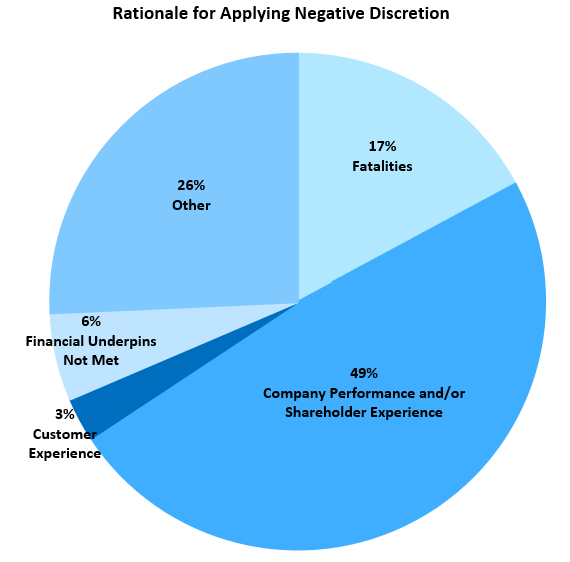
Negative Discretion
In the last year, the most common reason for exercising negative discretion was to better reflect the overall company performance or shareholder experience, cited in around 50% of cases, while almost a fifth were adjustments relating to fatalities. The typical reduction was between 10% and 25%.
Positive Discretion
Positive discretion examples were much more limited, with only eight FTSE 350 companies applying positive adjustments. As shown below, the most material adjustments were made in exceptional circumstances, such as the sale of a business for a material premium. In more ‘business as usual’ cases, adjustments made were more moderate with a typical impact of 5%-15% or less. In these cases, a common theme was to recognise significant activities related to strategy execution (such as corporate restructuring, divestments, growth-focused initiatives).
Annual Bonus – Positive Discretion Examples
| Example | Rationale | Adjustment Impact | AGM Outcome |
|---|---|---|---|
| 1 | Financial metrics not met; however, outturn was reviewed in the context of broader performance, including premium of c.75% delivered on sale of business and TSR of 200% over a three-year period. Other considerations included underlying performance and performance against peers. | 0% to 70% of maximum | N/ATransaction to sell business completed |
| 2 | Profit and revenue metrics below threshold. Bonus awarded at threshold level in light of overall Group performance and volatile macroeconomic environment including evolving tariff policy that was unforeseen when targets were set. | 0% to 20% of maximum | 96% |
| 3 | Very strong shareholder experience during the year and successful execution of refreshed strategy including corporate restructuring and divestments. | 49% to 56% of maximum | 97% |
| 4 | Divergence in wider workforce and executive director outcomes, leading to ELT outcomes lower than those of direct reports. | 34% to 47% of maximum | 64% |
| 5 | In light of the impact of the US tariffs announced after targets set, an on-target outcome was awarded to more fairly reflect performance. | Adjustment of less than 1% to 66% of maximum |
95% |
| 6 | Customer measure marginally below maximum and not considered to fully reflect quality of delivery during the year. | Adjustment of less than 1% to 100% of maximum |
99% |
PSP – Positive Discretion Examples
| Example | Rationale | Adjustment Impact | AGM Outcome |
|---|---|---|---|
| 7 | EPS outcome (60% weighting) below threshold. Vesting outcome not consistent with strong performance over three-year period, exceptional personal contributions of senior management team and strategic progress achieved. Discretion used to vest EPS element at two-thirds of maximum.Note: minor upward adjustment also made to the bonus outcome to 72% of maximum, but exact impact not disclosed. | 11% to 51% of maximum | 94%Significant individual shareholder |
| 8 | Formulaic outcome did not represent fair alignment between pay and performance, given strong execution of strategic priorities including materially improving overall business performance in a challenging market environment, completion of a transaction, and implementing growth-focused initiatives. | 44% to 48% of maximum | 96% |
Only one of the above companies received less than 80% support (with ISS recommending a vote ‘against’ the DRR), where the increased outcome was not considered aligned with the wider shareholder experience and concerns were raised about the company’s historic use of discretion.
The above shows that, while rarely used, there is some openness to positive discretion where it is well reasoned. Investor acceptance appears to depend less on whether positive discretion is applied and more on whether the rationale is clear, proportionate, and supported by evidence of wider shareholder experience and pay-for-performance link.
Positive and Negative Discretion Examples – Impact
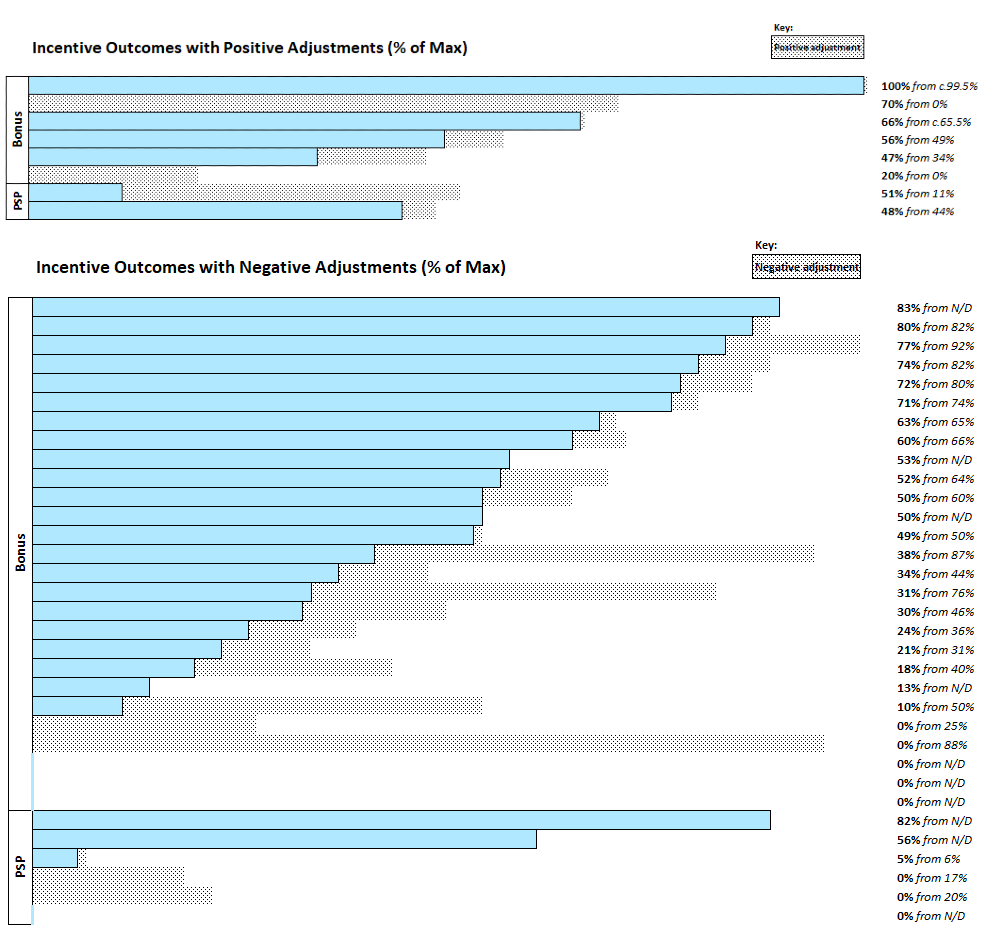
Note: The charts above show the impacts of positive and negative adjustments where disclosed in the DRR (N/D indicates no disclosure of the impact of adjustments made)
Interestingly, a number of the companies shown in the charts above did not disclose what the formulaic outcome would have been prior to the application of discretion. Whilst this is unlikely to draw investor attention where companies are applying negative discretion, in situations of positive adjustment there is a risk that some investors may assume that the impact was greater than it was in reality (for example, increasing incentive outcomes from 0% to 100% of maximum in the most extreme scenarios).
Some companies may therefore prefer to be fully transparent where positive discretion has been applied and to also disclose the formulaic outcome. This is likely to be better received by investors and allows them to accurately consider whether the adjustment is proportionate and fair.
Adjustments Versus Discretion – A Grey Area
Alongside the use of discretion, 29 FTSE 350 companies adjusted the calculation or methodology behind performance metric assessment. More than half of these adjustments were associated with corporate events and used to preserve the original intent of targets, i.e. to make them ‘no more or less difficult to satisfy’. Often, these adjustments followed acquisitions, disposals, capital events, or other significant business changes that altered the basis on which the original targets were established.
Further adjustments were also made to remove the impact of a range of one-off costs relating to restructuring, digital transformation projects, changes to pension and tax rates, or other costs associated with matters ‘outside of management control’ – around 20% of adjustments were made on this basis, with disclosure typically more factual explanations provided in the single figure table footnotes and attracting less investor commentary. In these cases, a set of principles may be in place to provide guidance or ‘guardrails’ to remuneration committees and/or investors around adjustments of this nature which may be considered.
Considerations and Practical Tips
We would highlight a number of considerations for reward teams and remuneration committees in approaching the use of discretion.
- Don’t leave the discussion until the year end. Tracking in-flight awards throughout the performance period allows for oversight of any emerging or unexpected outcomes that are considered misaligned with company performance and/or wider stakeholder experience. Planning ahead allows time for any potential adjustments to be debated and considered, and to engage with investors in advance.
- Test the narrative. Consider the company’s history of discretionary adjustments, and test whether the rationale for any use of discretion can be evidenced in a compelling way, in particular where positive adjustments are proposed.
- Consider materiality and proportionality. Consider the monetary impact of any adjustment and whether it feels proportionate and fair. Investors will closely scrutinise the use of discretion with a material impact and expect to see robust evidence of exceptional circumstances.
- Manage expectations in the process. The use of discretion (both negative and positive) can be a sensitive area and can be seen as a ‘test’ of the board’s support for management. Managing all stakeholders’ expectations is important to maintain trust and clearly explain and communicate decisions.
- Question whether shareholder consultation is needed. Is shareholder consultation required and in what format? In most cases of positive discretion, engagement with the largest investors will be carried out to ensure support and address any concerns in advance.
Looking Ahead:
While we have seen UK boards more empowered to set incentive levels appropriate for the talent market in which they operate, positive discretion remains a rarely used lever. This reflects a broader lack of global consistency in investor and proxy adviser acceptance: for example, discretion and adjustments are common practice in the US, but remain closer to a ‘red line’ in jurisdictions such as Australia.
In an increasingly volatile environment where corporate strategies are shifting fast, the ability to exercise judgement and discretion at the end of the performance period may prove as important as the targets themselves. Investor support will be conditional on a robust process and a clearly explained rationale. Fairness of decisions must be capable of being explained not only to management, but also to shareholders, employees and wider stakeholders.
Should you wish to discuss these updates or other market developments, please contact either Alison Barton (alison.barton@farient.com), Stephen Cahill (stephen.cahill@farient.com), David Cohen (david.cohen@farient.com), Fiona Maurice (fiona.maurice@farient.com) or Alex Styles-Morris (alex.styles-morris@farient.com).
|
Alison Barton
 📍 51 Moorgate, 5th Floor, London, EC2R 6LL 📞 +44 7501 282453 |
Stephen Cahill
 📍 51 Moorgate, 5th Floor, London, EC2R 6LL 📞 +44 7784 474845 |
David Cohen
 📍 51 Moorgate, 5th Floor, London, EC2R 6LL 📞 +44 7538 901395 |
|
Fiona Maurice
 📍 51 Moorgate, 5th Floor, London, EC2R 6LL 📞 +44 7572 494214 |
Alex Styles-Morris
 📍 51 Moorgate, 5th Floor, London, EC2R 6LL 📞 +44 7773 904547 |
© 2026 Farient Advisors LLC. | Privacy Policy | Site by: Treacle Media